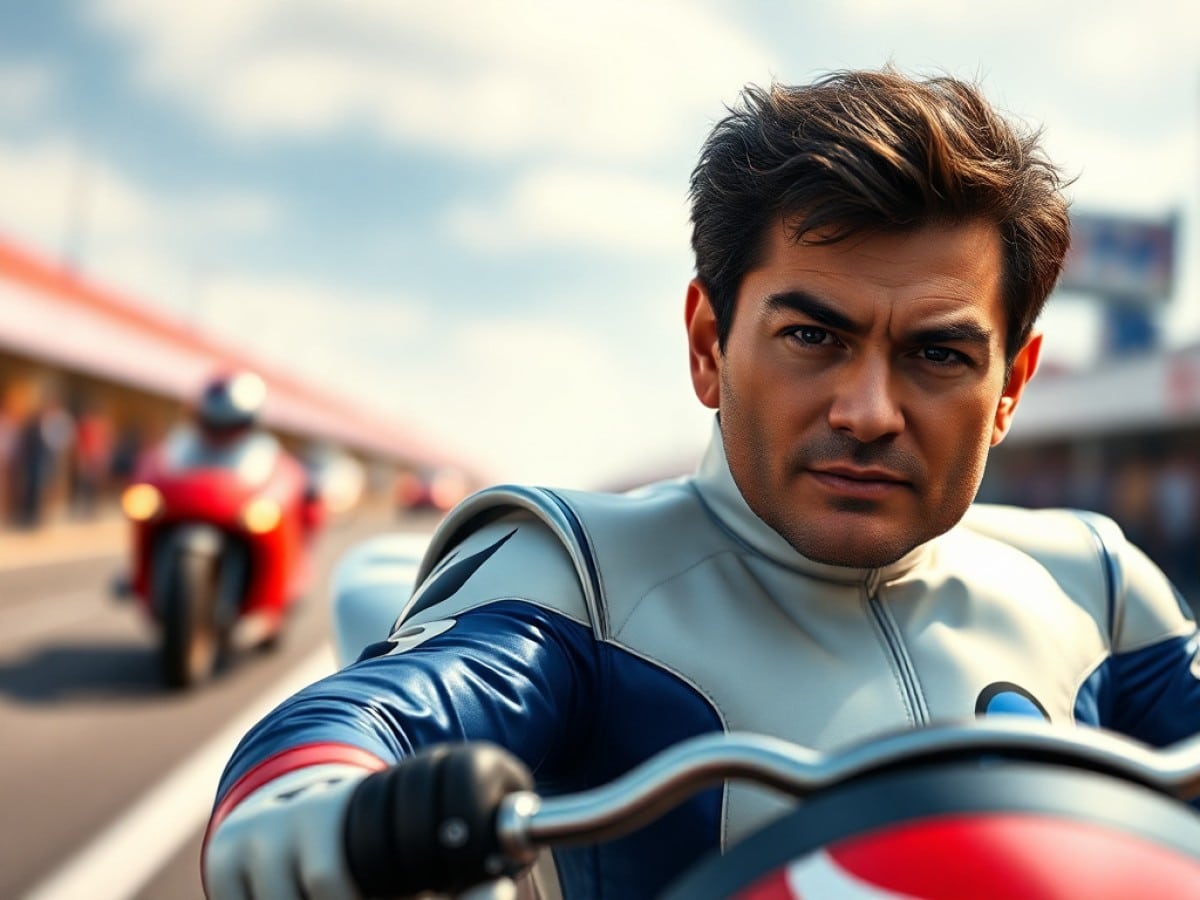
Almost two decades have passed since Speed Racer did not perform well at the box office, and its main actor believes he understands why it wasn’t a hit.
The 2008 movie was a live-action version of the anime series created by Tatsunoko Production, featuring Call of the Wild star Emile Hirsch as the talented young racer. Directed by the Wachowskis, the film marked their return after concluding the original Matrix trilogy, but it did not achieve similar success.
During a recent interview with ScreenRant‘s Grant Hermanns, coinciding with the release of a 4K remaster of the movie, Hirsch discussed the initial poor reception of Speed Racer. He started by noting, “it’s been pretty incredible seeing the evolution of the film,” despite its rough start, being “really kind of tarred and feathered” upon its 2008 release. Hirsch suggested that the film’s failure was due to the cinematic tastes of the audience at the time, which favored different types of films, particularly those with a more realistic approach like the superhero movies of the era:
Emile Hirsch: I feel like audiences have just changed in the last 18 years, and a lot of the stylistic visual aesthetic things that alienated people then now draws them in a different way that they maybe never even have seen before. I think there’s that, and then there’s also this sincerity that the movie has, and this sense of heart. That’s just something that I feel like has become a little rarer in a lot of superhero movies where there’s this deep, deep sincerity and wholesomeness. I think that Speed Racer has that in spades.
Hirsch also mentioned a previous anniversary screening of Speed Racer at the New Beverly theater, where “people were already talking about how much they loved the film” and referred to it as a “cult classic.” He highlighted the emotional response to the movie’s climax where Speed narrowly wins the Grand Prix, with “you could hear everybody crying in the theater,” a reaction not seen in its initial release:
Emile Hirsch: But seeing everyone in the theater now watch it, and seeing them get that emotional, it was really beautiful. And that was when I was like, “Oh wow, this really is a film that people are going to love forever.” Because for a film to have that kind of cathartic effect on an audience, especially a PG movie called Speed Racer, there’s something really special there that it’s not about the effects, it’s the heart and the art behind it.
Hirsch has often spoken openly about the film’s initial box office failure and its growing status as a cult classic, previously expressing surprise at its initial reception and wondering why “nobody gets” what they were trying to do. He compared it to the original anime’s performance, which only ran for three seasons, “not very much for a huge children’s show.”
Regarding the movie’s failure, the shift in audience preferences in blockbuster movies played a significant role. The success of Christopher Nolan’s The Dark Knight and Robert Downey Jr.’s Iron Man around the same time underscored the popularity of the superhero genre with a more realistic touch, which likely overshadowed Speed Racer at the box office. It faced stiff competition from other major releases like Indiana Jones and the Kingdom of the Crystal Skull and Chronicles of Narnia: Prince Caspian.
Speed Racer was not the only movie to suffer at the box office due to changing interests. The superhero genre, in particular, saw many films trying to replicate the success of The Dark Knight without success, such as the 2015 Fantastic Four reboot, earlier DC Extended Universe films, and the 2014 RoboCop reboot.
Similarly, other hyperstylized films like Edgar Wright’s Scott Pilgrim vs. the World, despite a big cast and positive reviews, didn’t perform well at the box office, grossing just under $48 million against a budget reportedly as high as $80 million.
While Speed Racer may not have been a hit initially, its legacy isn’t solely defined by its box office performance. As Hirsch pointed out, the film’s genuine tone and memorable characters have elicited strong responses from audiences over the years, helping it achieve status as a cult classic and maintaining its relevance compared to other films released during the same period.

Ava Thornton is an entertainment journalist with a keen eye for the latest in Hollywood, indie films, and streaming trends.
Her work blends insider knowledge with a deep appreciation for storytelling.